
See why users convert. Never who they are.
Respectlytics shows the paths that lead to a purchase and the steps where people give up, so you know what to fix next. No user IDs, no device IDs, nothing stored on the phone, and a short entry in your privacy label.
Free for one app and 20,000 events a month, no card needed.
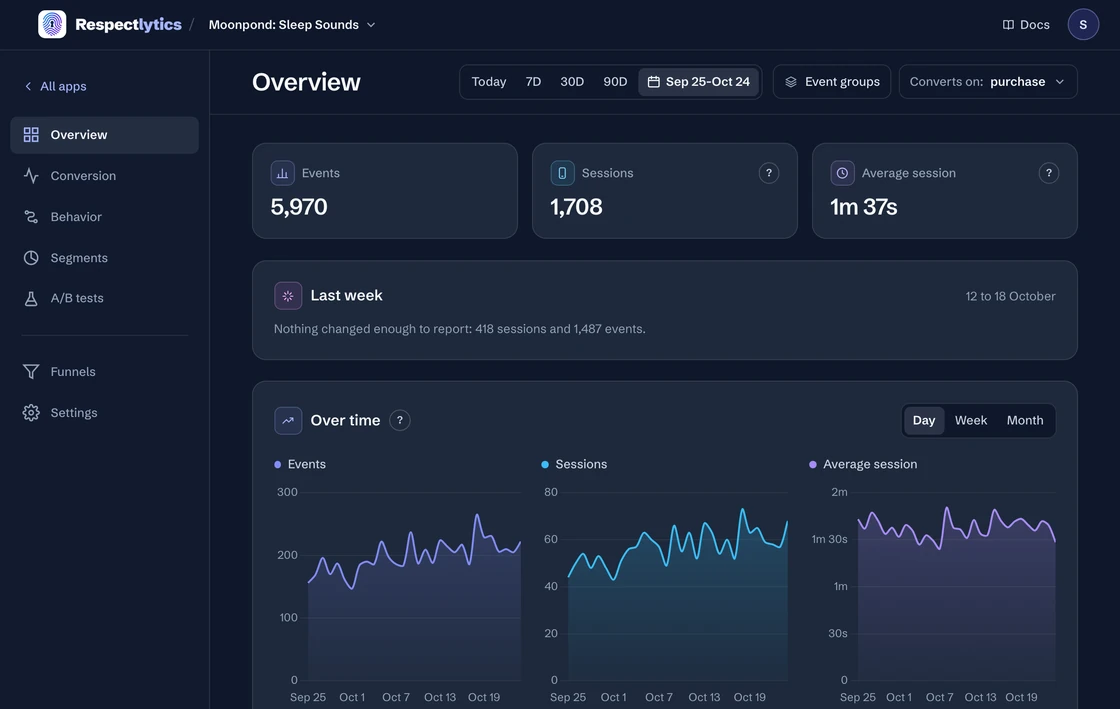
Ask your AI assistant about your app
Connect your coding assistant and ask in plain words. It reads your figures from Respectlytics and can open the code behind them.
Works with Claude Code, Codex, Cursor, VS Code, OpenCode and any MCP client.
Are all my events arriving after this release?
Read 14 track() calls in this project
Respectlytics: check_events
paywall_viewed stopped arriving from Android three days ago, while iOS still sends it. The call went missing when PaywallScreen.kt was rewritten.
+ Respectlytics.track("paywall_viewed")
What you no longer have to deal with
Each one is removed by how the SDKs and the API are built, not by a setting someone can forget.
A tracking prompt from your analytics
The SDKs never read the IDFA or the Android Advertising ID, so they add no ATT prompt and no AD_ID permission.
A long privacy label
Five fields and only the properties you declare make a short, explainable entry in your App Store privacy label and Google Play Data Safety form.
Identifiers on the phone
The session ID and the event queue live in memory. Nothing is written to the device for analytics.
Personal data in your analytics
No user IDs, device IDs or IP addresses are stored, so there is nothing about one person to look up or protect.
What you see in Respectlytics
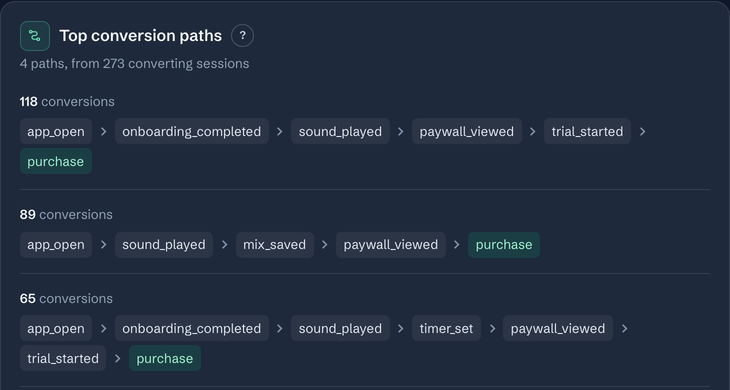
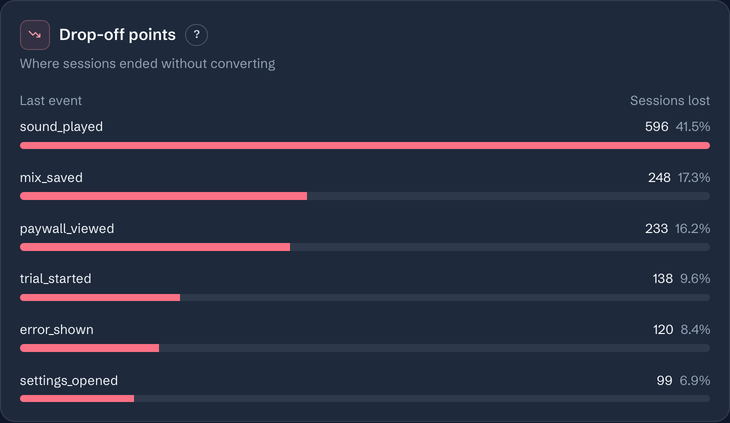
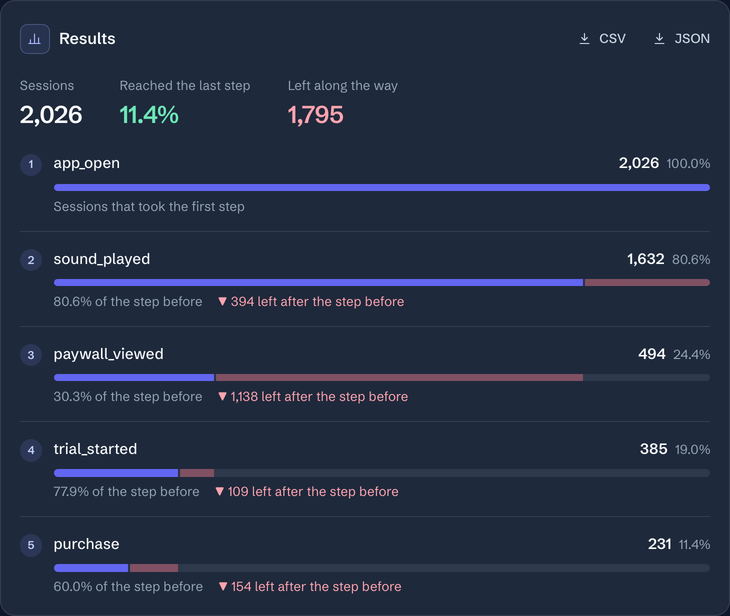
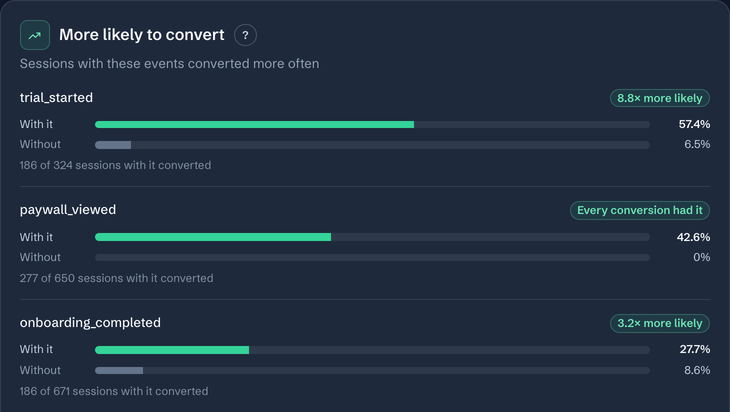
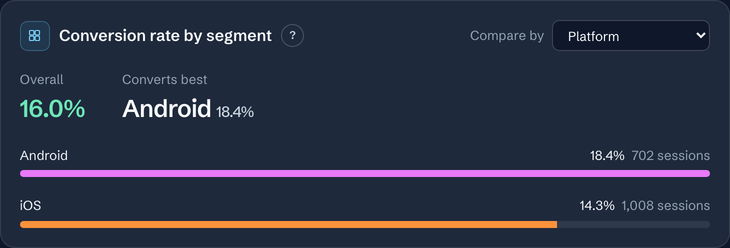
All of it comes from the five stored fields and only the properties you declare. Nothing about who the user is.
One line per event
Configure the SDK once at launch, then call track() where things happen.
Respectlytics.configure(apiKey: "your-api-key")
Respectlytics.track("signup_completed")
Respectlytics.track("purchase_completed")
Respectlytics.configure(Configuration(apiKey = "your-api-key"))
Respectlytics.track("signup_completed")
Respectlytics.track("purchase_completed")
await Respectlytics.configure(apiKey: 'your-api-key');
await Respectlytics.track('signup_completed');
await Respectlytics.track('purchase_completed');
Respectlytics.configure('your-api-key');
Respectlytics.track('signup_completed');
Respectlytics.track('purchase_completed');
Using an AI coding assistant? Connect Respectlytics to it, and it can add the SDK and check that your events arrive. The event plans show what to track in each part of an app.
Trust you can check
Privacy you can read in the code, and analytics stored in the EU.
Open source
MIT-licensed SDKs and an AGPL-3.0 server. Read what runs in your app and what the API keeps.
Self-host for free
The Community Edition runs on your own servers with Docker and PostgreSQL.
Stored in the EU, made in Sweden
Every account's events are stored and analysed in the EU, with a published DPA.
Why teams choose Respectlytics
It finds the answers, tells you when something changes, and keeps every feature on every paid plan.
The analysis runs by itself. Name your conversion events, and Respectlytics works out the paths that lead there, the steps where sessions end and the events that go with converting.
You hear about changes the same day. Alerts by email, Slack or webhook when an app goes quiet, an event stops arriving, the day's events jump or drop, or conversion falls. On paid plans.
What changed, every Monday. A short email with what moved in each of your apps last week, and a link to the view that shows it. On every plan.
A/B tests without profiles. Declare a property such as a paywall version, and see how the sessions with each variant convert. On paid plans.
Every feature on every paid plan. Unlimited apps, team members and two years of history on all of them. You choose only how many events a month.
Free to start, with no card. One app and 20,000 events a month on the free plan, with no time limit, and an upgrade whenever you need more.
Find your starting point
Whether you are switching tools, planning events or working in a sensitive field.
Questions buyers ask
Straight answers to what teams ask before they choose.
What is privacy-first mobile app analytics?
Analytics built so that it never needs to know who a user is. Respectlytics stores five fields per event: the event name, a rotating session ID, a timestamp, the platform and the country, plus only the properties you declare. It reads no device identifiers and writes nothing to the phone, and still shows conversion paths, drop-offs and funnels.
How does it count users without tracking them?
It counts sessions, not people. Each session gets a random ID that lives in memory and is replaced every two hours and on every launch. The server stores a hash of it salted with your app and the date, so sessions are never linked to each other.
How is it different from Firebase or Mixpanel?
They are built around people, with IDs that follow one user across days. Respectlytics is built around sessions and steps: it finds the paths that lead to a conversion and the steps where people give up, without storing anything that identifies a person.
Do I still need a consent banner or the ATT prompt?
Your legal team decides that, based on everything your app does. Respectlytics never reads the IDFA and writes nothing to the device for analytics, so it gives your app no reason to show the ATT prompt.
Can I host it myself?
Yes. The Community Edition is free and open source under AGPL-3.0 and runs with Docker and PostgreSQL. The hosted service adds the weekly email and AI assistants on every plan, and properties, A/B tests, same-day alerts and team members on paid plans, with no server to run.
Can I ask my AI assistant about my analytics?
Yes. Connect Claude Code, Codex, Cursor, VS Code or another assistant that speaks MCP, and ask in plain words. It reads totals over days, never a single event or session, and it only reads. It is on every plan, and your conversation never reaches us.
How is it priced?
A free plan covers one app and 20,000 events a month, with no credit card and no time limit. Every paid plan has every feature and unlimited apps; you choose only how many events a month. Prices are on the pricing page.

Why I built Respectlytics
I have developed several mobile apps over the years, and analytics was always one of the hardest problems because of privacy. I have no interest in tracking people, but like any app developer, I need to understand how my apps are used and how to improve them.
So I built my own solution. Respectlytics is built to track events, not people. It solves my problem, and I hope it helps other app developers and businesses too.
Try it on your own app
Free for one app and 20,000 events a month, no card needed. Unlimited apps on every paid plan.